Text size: Watch Exo WorkNeed help?

How To Help A Parent Who Is Being Scammed (And Won't Believe You)

If your mum or dad is being scammed and won't believe you, stay calm, keep talking and avoid blame. Ask questions rather than arguing, show them real examples of the same scam, and involve their bank early. If money has gone, call the bank straight away and report it. Here's what tends to help.

Last checked: 15 October 2026

Quick Steps

  1. Stay calm and keep the conversation going.
  2. Ask questions instead of arguing.
  3. Show them real warnings about the same scam.
  4. If money has gone, call their bank straight away.

Why Won't My Parent Believe Me?

People who are being scammed are not foolish. Scammers are professionals. They spend weeks building trust, flatter and listen, and often tell their victim to keep things secret or warn them that family "won't understand". By the time you find out, your parent may feel embarrassed, attached to the person, or afraid of losing money they've already sent. Arguing head-on can make them defend the scammer even harder.

AI has made this worse. Scammers now use AI-made photos, videos and even cloned voices, so the "person" can look and sound convincing. A common reply is: "If they're not real, how did they send me a picture?"

What Are The Signs Something Is Wrong?

  • A new online friend or romance they've never met in person, who always has a reason not to video call or meet.
  • Requests for money, gift cards, cryptocurrency or wire transfers, often for an emergency, a fee or a "guaranteed" investment.
  • Secrecy: they hide their phone, take calls in another room or say "they told me not to tell anyone".
  • Calls from "the bank", "the police", "the FBI" or "HMRC" telling them to move money to a "safe account".
  • Unusual withdrawals, new cards or apps on their phone they can't explain.

What Helps When Talking To Them?

  1. Stay calm and stay close. Your relationship is the strongest protection they have. If they shut you out, the scammer wins.
  2. Ask questions instead of making accusations. "How did you meet?" "Have you ever video called?" "What would happen if you said no?" Let them notice the gaps themselves.
  3. Show, don't tell. A reverse image search on a profile photo can show the same picture on other names (see Google Lens). Real news stories about the same script can help too.
  4. Suggest a simple test. A live video call, or calling the bank on the number printed on the back of their card. Genuine people and organisations will pass. Scammers make excuses.
  5. Bring in someone they trust. Sometimes a bank, doctor, faith leader or old friend is listened to more than a son or daughter.
  6. Protect the money quietly. Ask their bank about safeguards. Many banks let customers add a trusted contact or extra checks on large payments.
  7. Keep the door open. If they aren't ready to listen today, say "I'm always on your side, whatever happens". Many people come round once the scammer asks for "just one more" payment.

What Should I Avoid Saying?

  • Calling them stupid, or saying "I told you so". Shame makes people hide things.
  • Confronting the scammer yourself or sending them money to "make it stop".
  • Taking over their accounts without their agreement, unless you have the legal right to (for example a power of attorney). Get proper advice first.
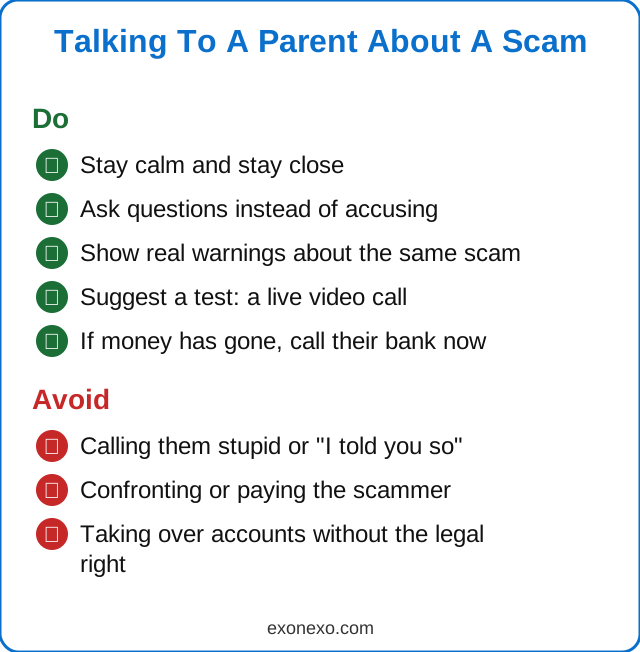
Talking to a parent about a scam. Do: stay calm and stay close; ask questions instead of accusing; show real warnings about the same scam; suggest a test such as a live video call; if money has gone, call their bank now. Avoid: calling them stupid or saying I told you so; confronting or paying the scammer; taking over accounts without the legal right.
What helps, and what to avoid, when you talk to a parent you think is being scammed.

What If Money Has Already Gone?

  1. Call their bank straight away, using the number on the back of their card.
  2. Report it (see below). Keep messages, numbers and receipts as evidence.
  3. Watch out for "recovery" scams: people who promise to get the money back for a fee are usually the same criminals.

USA: Get Help

National Elder Fraud Hotline: 1-833-372-8311 (free, run by the Department of Justice). Report fraud to the FTC at reportfraud.ftc.gov and online crime to the FBI at ic3.gov.


UK: Get Help

Call 159 to reach most UK banks safely. Report fraud at reportfraud.police.uk or call 0300 123 2040. Forward scam texts to 7726.

Worried about fake "emergency" calls in a loved one's voice? Our voice-cloning guide explains how to set up a family safe word. Print our Scam Cheat Sheet and leave it by their phone.

Common Questions

My parent says the person is real because they sent photos. What do I say?

Photos and even short videos can now be made by AI, or stolen from someone else's social media. A live, unplanned video call is a much better test, and so is a reverse image search on the photo.

Can I stop the bank paying out?

You can't usually block payments on someone else's account yourself, but you can raise your concerns with their bank, and your parent can agree to extra checks or a trusted contact. A power of attorney gives more control, and needs legal advice.

What if they get angry with me?

That's very common. Step back, keep in touch and keep things warm. Many people only accept it was a scam later, and they need to know they can come to you without being judged.

Who can I call for advice about a parent being scammed?

In the USA, the National Elder Fraud Hotline (1-833-372-8311) helps with fraud against anyone aged 60 or over. In the UK, Age UK offers support, and fraud can be reported to Report Fraud on 0300 123 2040 (Police Scotland on 101).

New to all this? Our free AI Starter Guide walks you through the basics, and you can print it.

Sources

Last checked 16 October 2026.

Read Next

About The Author

Robert Woolford is the founder of exonexo, a simple guide to AI tools, AI news and scam safety for beginners. Spotted a mistake or have a question? Email info@exonexo.com. Read our Editorial Policy.

Updated 24 October 2026