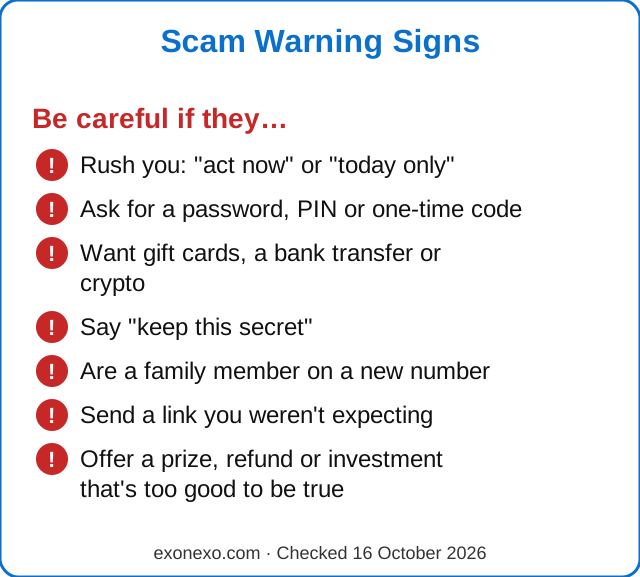
If a message or call asks you to act fast, pay in an unusual way, share a code or keep it secret, treat it as a scam until you have checked. Tick the boxes below. Even one tick means stop, and check using a number you already trust.
Based on the official FTC, NCSC and Report Fraud websites.
Tick Any That Apply
Tick any that apply.
I Ticked A Box. What Do I Do Now?
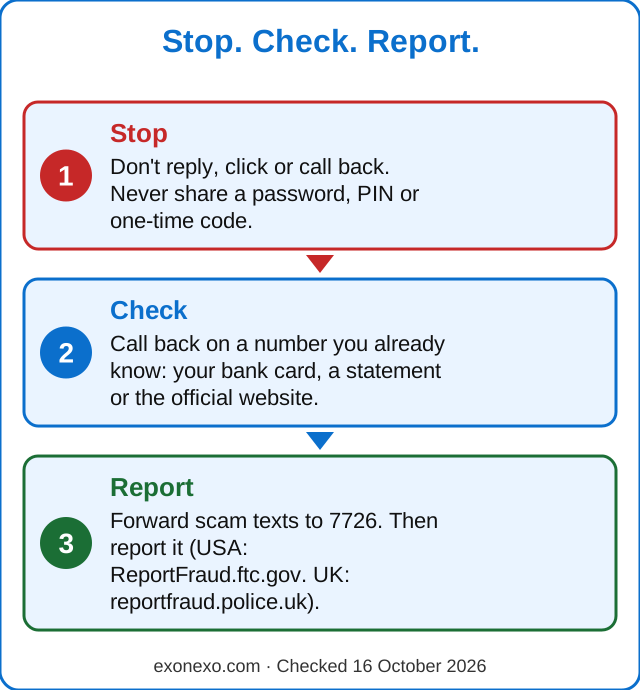
Stop. You haven't lost anything yet. Scammers rely on you acting fast. Taking ten minutes to check is the safest thing you can do.
Don't reply, click or call back. Even replying "STOP" tells a scammer your number works. Don't ring the number in the message, even if it looks like your bank's.
Check it yourself, a different way. Find the number on your bank card, a recent statement or the company's official website, and call that. If the message says it is from a family member, ring them on the number you already have.
Ask someone you trust. A family member, a friend or your bank can tell you if it looks wrong. Free checkers such as Bitdefender Scamio or Norton Genie can give a second opinion, but treat their answer as advice, not proof.
Report it, then delete it. The reporting details for the USA and UK are below.
If you've already paid or shared a code, call your bank straight away on the number on the back of your card. The sooner you call, the better the chance of stopping the payment.
Something to say: if someone pressures you on the phone, say "I'll call you back on your official number," then hang up.
Stop, check, report: the three steps to take with any message or call you're not sure about.
Why Do These Warning Signs Matter?
Each box on the checklist matches a trick scammers use again and again.
Rushing you. "Today only" or "your account will be closed" is meant to stop you thinking or asking anyone.
Asking for a code. A one-time code sent to your phone is the key to your account. Your bank will never ask you to read it out.
Odd ways to pay. Gift cards, bank transfers and crypto are hard to get back. Real companies and government offices don't ask for gift cards.
"Hi Mum, I've got a new number." A message from a family member on a new number, asking for money, is a common scam. Call their old number to check.
Keeping it secret. Scammers tell you not to tell your family or your bank because those people would spot the scam.
The warning signs at a glance. Any one of them is a reason to stop and check.
Where Do I Report A Scam?
USA
Scam texts: forward them to 7726 (it spells SPAM). This helps your phone company block them.
Any scam: report it to the Federal Trade Commission (FTC) at ReportFraud.ftc.gov.
Lost money? Call your bank or card company straight away, then report it to the FTC.
UK
Scam texts: forward them to 7726. It's free.
Scam emails: forward them to report@phishing.gov.uk, run by the National Cyber Security Centre (NCSC).
Suspicious call about your bank? Hang up and call 159. It connects you safely to most UK banks.
Lost money or been hacked? Call your bank, then report it to Report Fraud (it replaced Action Fraud in December 2025) at reportfraud.police.uk or on 0300 123 2040. This covers England, Wales and Northern Ireland. In Scotland, call Police Scotland on 101.
Print it: our one-page Printable Scam Cheat Sheet has the warning signs and who to call, in large type. Stick it by the phone.
Common Questions
What should I do if I clicked a link in a scam text?
Don't type anything into the page that opened. If you entered a password, change it straight away on the real website. If you entered bank details, call your bank on the number on your card.
Is it safe to reply STOP to a scam text?
No. Replying tells the scammer your number is real. Forward the text to 7726 instead, then delete it.
Who do I report a scam to in the UK?
Forward scam texts to 7726 and scam emails to report@phishing.gov.uk. If you lost money, call your bank, then report it to Report Fraud at reportfraud.police.uk or 0300 123 2040. In Scotland, call Police Scotland on 101.
Who do I report a scam to in the USA?
Forward scam texts to 7726 and report the scam to the FTC at ReportFraud.ftc.gov. If you lost money, call your bank or card company first.
What is Report Fraud?
Report Fraud is the UK's national service for reporting fraud and cyber crime in England, Wales and Northern Ireland. It replaced Action Fraud on 4 December 2025. The phone number, 0300 123 2040, stayed the same.
Can my bank get my money back?
Sometimes. Call your bank as soon as you can on the number on your card. The faster you act, the better the chance.
New to all this? Our free AI Starter Guide walks you through the basics, and you can print it.