USA
Report it to the FTC at ReportFraud.ftc.gov. If you've sent money, call your bank or payment company straight away.


Scammers can copy a loved one's voice from a short clip online, then call you claiming to be in trouble and needing money fast. The voice can sound exactly right. If a call asks for urgent money and secrecy, hang up and ring that person back on the number you already have.
Advice is based on guidance from the US FTC and FCC.
The US Federal Trade Commission (FTC) explains that a scammer only needs a short recording of someone's voice, perhaps from a video on social media, plus a voice-cloning program.
They call you sounding like your grandson, daughter or friend. There has been an accident, an arrest or a lost wallet abroad, and they need money right now. Sometimes a second person comes on the line pretending to be a lawyer, a police officer or a doctor.
The scam works because the voice sounds real and the story is frightening. Fear makes it hard to think clearly. That is exactly what the scammer wants.
Something to say: "I'm going to hang up and call you straight back on your usual number." A scammer will try to stop you. A real person won't.
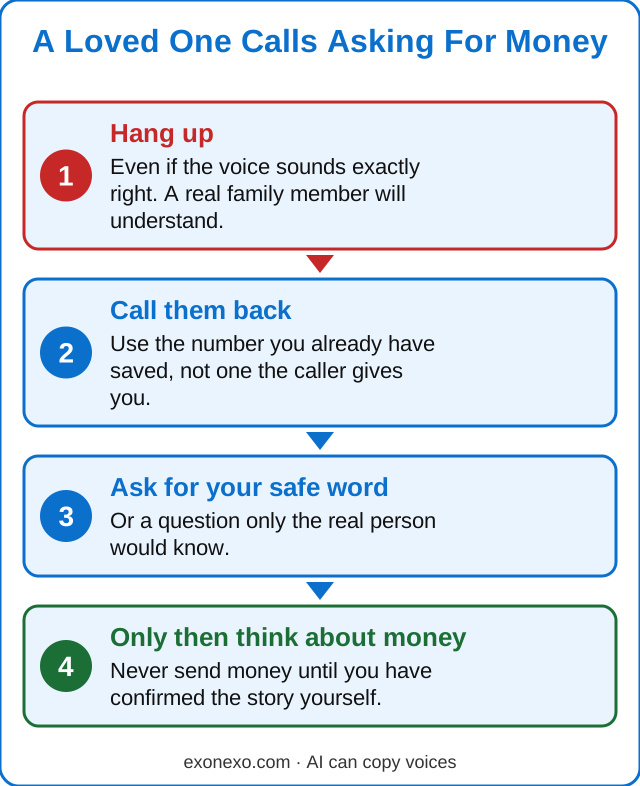
The US Federal Communications Commission (FCC) suggests agreeing a safe word with your family ahead of time. If a caller can't give it, treat the call as a scam.
You don't need to stop sharing family videos. A few small steps help:
Report it to the FTC at ReportFraud.ftc.gov. If you've sent money, call your bank or payment company straight away.
If the call is about your bank, hang up and call 159 to reach your bank safely. If you've lost money, call your bank, then report it to Report Fraud at reportfraud.police.uk or on 0300 123 2040 (England, Wales and Northern Ireland). In Scotland, call Police Scotland on 101.
Not sure about a message rather than a call? Use our Is this a scam? checklist.
Yes. The FTC warns that scammers can clone a voice from a short recording, such as a video posted on social media.
A secret word or phrase your family agrees in person. If someone calls asking for money and can't give the word, treat the call as a scam.
That is a warning sign. Scammers ask for secrecy so nobody can stop you. Call another family member straight away.
No. Call the person on the number you already have saved for them. A scammer's number may look real but isn't.
In the USA, report it at ReportFraud.ftc.gov. In the UK, call your bank, then report it to Report Fraud on 0300 123 2040, or Police Scotland on 101 in Scotland.
New to all this? Our free AI Starter Guide walks you through the basics, and you can print it.
Last checked 16 October 2026.
Tick the warning signs, then find out who to report it to in the USA and UK.
Spot fake AI profiles and chatbots on social media.
One page, large type: warning signs and who to call in the USA and UK.
A short email every Thursday with new guides, one useful tip and the AI news that matters. Free, and you can unsubscribe at any time. See past issues.
Updated 24 October 2026