
What Is AI? Explained Simply
AI, short for artificial intelligence, means computer programs that can do jobs we used to think needed a person, like writing a letter, recognising a face or understanding speech. You probably use it already. Chatbots such as ChatGPT are the newest kind: you ask in everyday words and they reply.
Last reviewed: 16 October 2026.
Am I Already Using AI?
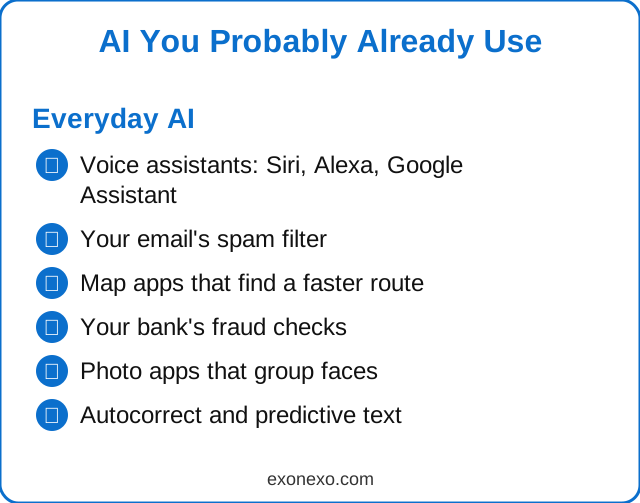
Very likely. AI has been quietly working in everyday things for years:
- Voice assistants like Siri, Alexa and Google Assistant, which understand what you say.
- Your email's spam filter, which spots junk mail before you see it.
- Map apps, which predict traffic and find a faster route.
- Your bank's fraud checks, which notice unusual spending on your card.
- Photo apps, which group your pictures by the people in them.
- Autocorrect and predictive text on your phone.
What Is A Chatbot?
The AI in the news is mostly chatbots, such as ChatGPT, Gemini and Microsoft Copilot. A chatbot is a program you talk to by typing or speaking, and it replies like a person would.
You don't need special commands. You can write "My boiler is making a banging noise. What could it be?" and get a helpful answer in simple terms.
How Does A Chatbot Work?
Think of a person who has read millions of books, websites and letters, and has become very good at guessing what words should come next.
That is roughly what a chatbot does. It learned patterns from a huge amount of text. When you ask a question, it builds an answer one word at a time, choosing words that fit the pattern. The technical name for this engine is a large language model.
This explains both its strengths and its weaknesses. It writes smoothly and knows about almost any topic. But it is predicting, not looking things up in a reliable book, so it can get facts wrong and sound completely sure. People call these mistakes hallucinations.
What Is AI Good For?
- Explaining a confusing letter, bill or form in simple terms.
- Drafting an email, a complaint letter or a short speech. See how to use AI to write an email.
- Ideas for recipes, gifts or a day out.
- Naming a bird, a plant or a song. See our best free AI apps for seniors.
- Reading small print out loud or making it bigger.
- Practising a language or learning about a hobby.
What Should I Be Careful About?
- It can be confidently wrong. Check anything that matters, especially health, money and legal questions.
- Keep private details out. Never type passwords, bank numbers or ID numbers. See is ChatGPT safe?
- Scammers use AI too, for fake voices, videos and emails. See how to spot a voice-cloning scam.
- Phone numbers and websites it gives you may be out of date or fake. See how to check them.
Do I Have To Pay For AI?
No. ChatGPT, Gemini and Copilot all have free versions, and they are enough for most people. Paid plans exist if you use them a lot. See how much AI chatbots cost.
How Can I Try AI In Five Minutes?
- On a computer, tablet or phone, go to chatgpt.com or gemini.google.com.
- Click or tap in the box at the bottom of the screen.
- Type: "Explain what you can help me with, in simple words." Then press Enter.
- Ask a follow-up, such as "Give me an example for someone who is retired."
- If the answer is too long, type "Shorter, please." It won't mind.
Words you might hear are explained in our simple AI glossary. You may also hear about AI that can take actions for you, which is explained in what is an AI agent?
Common Questions
What does AI stand for?
AI stands for artificial intelligence. It means computer programs that can do jobs that used to need a person, such as writing, recognising pictures or understanding speech.
Is AI the same as ChatGPT?
No. ChatGPT is one example of AI, called a chatbot. AI also includes voice assistants, spam filters, map apps and photo apps.
Is AI dangerous?
For everyday use it is mostly safe if you follow simple rules: keep private details out, check important answers and watch out for AI-powered scams.
Can AI think like a person?
No. A chatbot predicts likely words based on patterns it learned. It can sound human but it doesn't understand or feel things the way people do.
Do I need to be good with computers to use AI?
No. If you can send a text message, you can use a chatbot. You type or say your question in everyday words.
Is AI free?
The main chatbots, ChatGPT, Gemini and Copilot, all have free versions. Paid plans are optional.
New to all this? Our free AI Starter Guide walks you through the basics, and you can print it.
Sources
Last checked 16 October 2026.
Read Next
Simple AI Glossary
AI words explained simply, from chatbot to deepfake.
ChatGPT Vs Gemini Vs Claude
A simple comparison, with USA and UK prices.
Free AI Starter Guide
A printable 25-page guide to get started safely. Free PDF, no sign-up.
Get The Weekly exonexo Email
A short email every Thursday with new guides, one useful tip and the AI news that matters. Free, and you can unsubscribe at any time. See past issues.
Updated 24 October 2026